Chernobyl ships first seven processed waste packages to near-surface site
The Industrial Complex for Solid Radioactive Waste Management began operations in May under a licence from Ukraine's State Nuclear Regulatory Inspectorate.
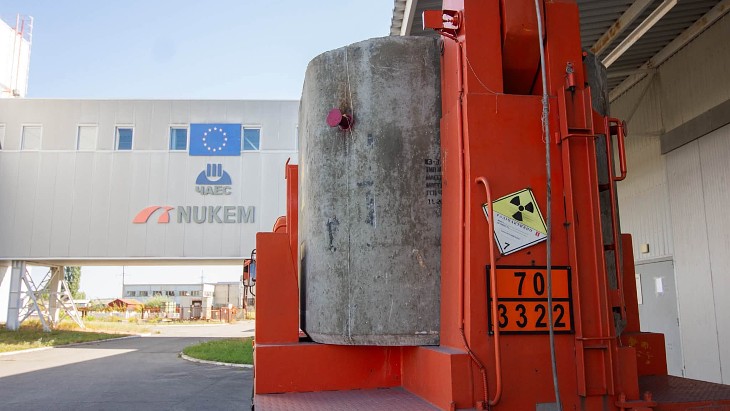
Key facts
- Retrieval runs at three cubic metres per day; waste is packed into 165-litre drums and compacted
- Waste comes from stores dating to 1978 at the Solid Radioactive Waste Storage Facility
- Receiving facility holds 55,000 cubic metres, accepts waste for 30 years and stores it for 300
- ICSRM was majority funded by the European Union and comprises four facilities
Chornobyl NPP has shipped seven packages of low- and intermediate-level radioactive waste from its Industrial Complex for Solid Radioactive Waste Management (ICSRM) for disposal at the Specially Equipped Near-surface Disposal Facility for Solid Radioactive Waste (ENDSF). The transfer is the first from the complex, which began operations in May after receiving a licence from the State Nuclear Regulatory Inspectorate of Ukraine.
The ICSRM processes solid waste accumulated while the plant operated, held at the Solid Radioactive Waste Storage Facility, which dates back to 1978. The waste includes used personal protective equipment, thermal insulation and cable insulation, cables, individual metal structures, soil, concrete, reinforcing steel and ion-exchange resins from water treatment system filters, the plant said.
Retrieval has a capacity of three cubic metres per day. Each batch undergoes radiological characterization, including checks for ionising radiation sources and other high-level waste that should not enter the processing stream. Waste is loaded into 165-litre drums and compacted before transport to the ENSDF.
The regulator approved commissioning of the Solid Waste Retrieval Facility and Solid Waste Processing Plant at the site in January last year.
The ICSRM was majority funded by the European Union and comprises four facilities integrated in a single technology cycle. It is part of SSE CERWM, the State Specialised Enterprise for Radioactive Waste Management. Its near-surface facility for low- and intermediate-level short-lived waste has a capacity of 55,000 cubic metres, will accept waste for 30 years and store it for 300 years.
The plant's four operating units were RBMK-1000 reactors. Unit 4 was destroyed in the 1986 accident; the other three shut down in 1991, 1996 and 2000. Two almost-completed units never entered service and are being decommissioned.