Hyundai E&C tests 1.75-meter equipment for used fuel deposition hole
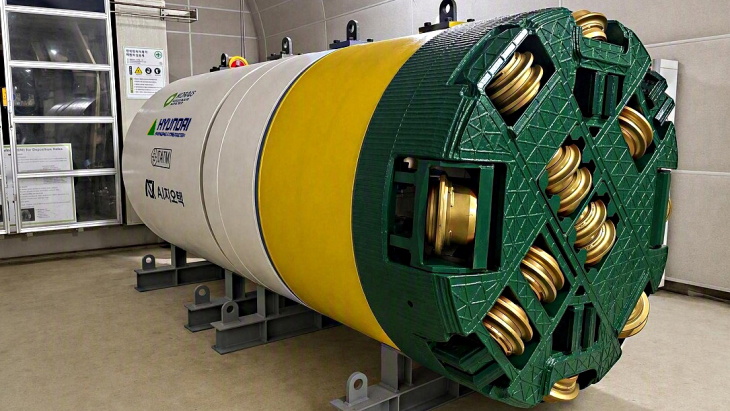
The 5.7-meter-long machine, built to KORADIS deposition hole specifications, was tested in an underground research tunnel under a KORAD-led R&D project.
Key facts
- Foldable cutterhead allows retrieval and reuse across multiple deposition holes
- Excavation data analyzed in real time with AI to optimize ground conditions
- LiDAR digital mapping verified construction quality and deposition hole suitability
- Special act requires interim storage by 2050 and permanent disposal by 2060
- Hyundai E&C is the only construction company in the KORAD-led project
Hyundai Engineering & Construction said it has excavated a full-scale deposition hole for used nuclear fuel disposal in bedrock at its research demonstration site, using equipment it developed.
The equipment measures 1.75 meters in diameter and 5.7 meters in length and is designed to meet the deposition hole specifications and construction conditions required by the Korea Advanced Disposal System (KORADIS), a disposal system developed for Korea's geological environment and technical conditions. It has a foldable cutterhead: once excavation is complete, the cutterhead is folded so the equipment can be safely retrieved and reused.
Hyundai E&C verified the equipment's performance and constructability by excavating a full-scale deposition hole in rock in an underground research tunnel. Excavation data was analyzed in real time using AI to assess ground conditions and optimize the work, and LiDAR-based digital mapping verified construction quality and the suitability of the hole.
The work is part of a government-funded R&D project on used nuclear fuel management led by the Korea Radioactive Waste Agency (KORAD). Hyundai E&C is the only construction company taking part, through the HMG Construction Technology Research Institute. It said it is extending its research to construction materials and rock engineering, including concrete and grout for engineered barriers and groundwater inflow control, and a rock classification system for Korea's geology.
In South Korea, used fuel is stored at each nuclear power plant site pending construction of a centralized interim storage facility, and many on-site facilities are nearing full capacity. In February 2025 the National Assembly passed an act providing for interim storage facilities for high-level radioactive waste by 2050 and permanent disposal facilities by 2060.