DOE nuclear office offers up to $50M for silicon carbide fuel cladding
Awards run three years and target fabrication of 12-foot cladding rods for irradiation testing in research reactors.
Key facts
- Applications due by December 7, 2026, through the Grants.gov funding opportunity
- Irradiation performance data needed for NRC licensing and commercial deployment, per DOE
- Silicon carbide said to withstand extreme reactor conditions and reduce operational costs
- Current reactors use uranium ceramic pellets in sealed metal tubes called cladding
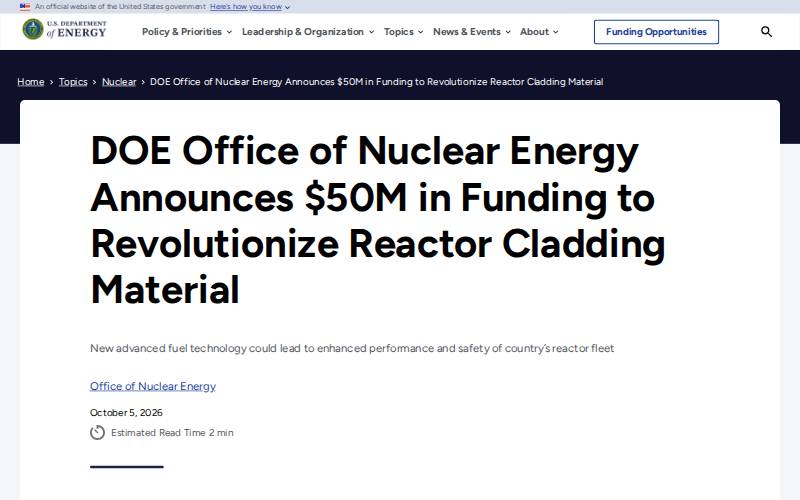
The U.S. Department of Energy’s Office of Nuclear Energy announced on October 5, 2026 a funding opportunity to accelerate research and development of silicon carbide cladding for nuclear fuel. Up to $50 million in competitive funding is available over three years, the office said. The office said the funding will support work to fabricate 12-foot silicon carbide cladding fuel rods for irradiation testing in research reactors, and that the step is intended to produce the irradiation performance data required for NRC licensing and commercial deployment of the material. Applications are due by December 7, 2026, the office said. Silicon carbide can withstand extreme conditions inside a reactor. Current reactor fuel uses uranium ceramic pellets stacked in metal tubes called fuel cladding, which are sealed at both ends to form fuel rods. The cladding separates reactor coolant from the fuel pellets.
