BGE narrows German repository search to under 5% of territory
The company plans to propose five to ten sites for surface exploration to the Federal Office for the Safety of Nuclear Waste Management by the end of 2027.
Key facts
- 36 sub-areas still under investigation in representative preliminary safety analyses, using four assessment steps
- 2020 list identified 90 areas covering 54% of Germany's surface area as potentially suitable
- Repository would hold about 1,900 containers, 99% of Germany's radioactivity
- Remaining areas lie in southern, eastern, and north and north-west Germany
- Final site decision scheduled for 2031, with use of the site targeted for 2050
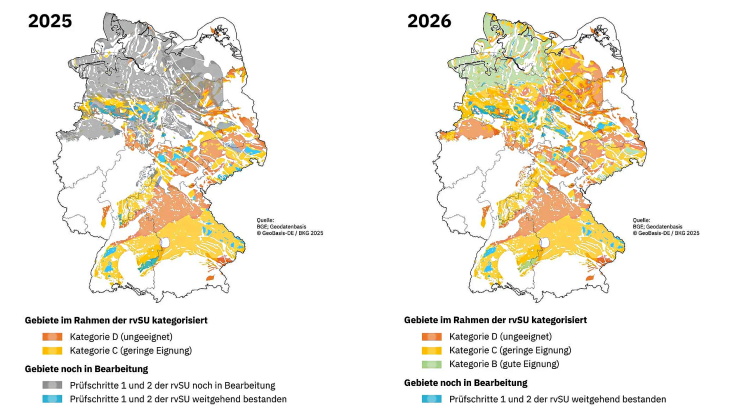
The Federal Company for Radioactive Waste Disposal (BGE) said on October 29 that it had reduced the area under consideration for Germany's high-level radioactive waste repository from about 25% of the country's territory to less than 5% over the past year.
Thirty-six sub-areas remain under investigation in the representative preliminary safety analyses, BGE said. They are located in southern Germany, eastern Germany, and the north and north-west of Germany. BGE intends to propose five to ten sites for surface exploration to the Federal Office for the Safety of Nuclear Waste Management by the end of 2027.
A final site selection decision is scheduled for 2031, with the aim of starting to use the site in 2050.
In September 2020, BGE published a list of 90 areas covering 54% of Germany's surface area as potentially geologically suitable. The list excluded a site at a former salt mine in Gorleben that had previously been considered suitable. The selected site would store about 1,900 containers of waste, which account for 5% of Germany's total nuclear waste but 99% of its radioactivity.