NASA seeks partners to design 20-kilowatt lunar reactor
NASA targets a launch-ready system by December 2030, with at least five years of operation planned after deployment.
Key facts
- 20 kilowatts of electric power, with output maintained after a single system failure
- Launch-ready by December 2030, per NASA’s solicitation timeline
- Designed to operate continuously for at least five years without maintenance
- Proposals due December 21; selected partners have 18 months for testing and demonstrations
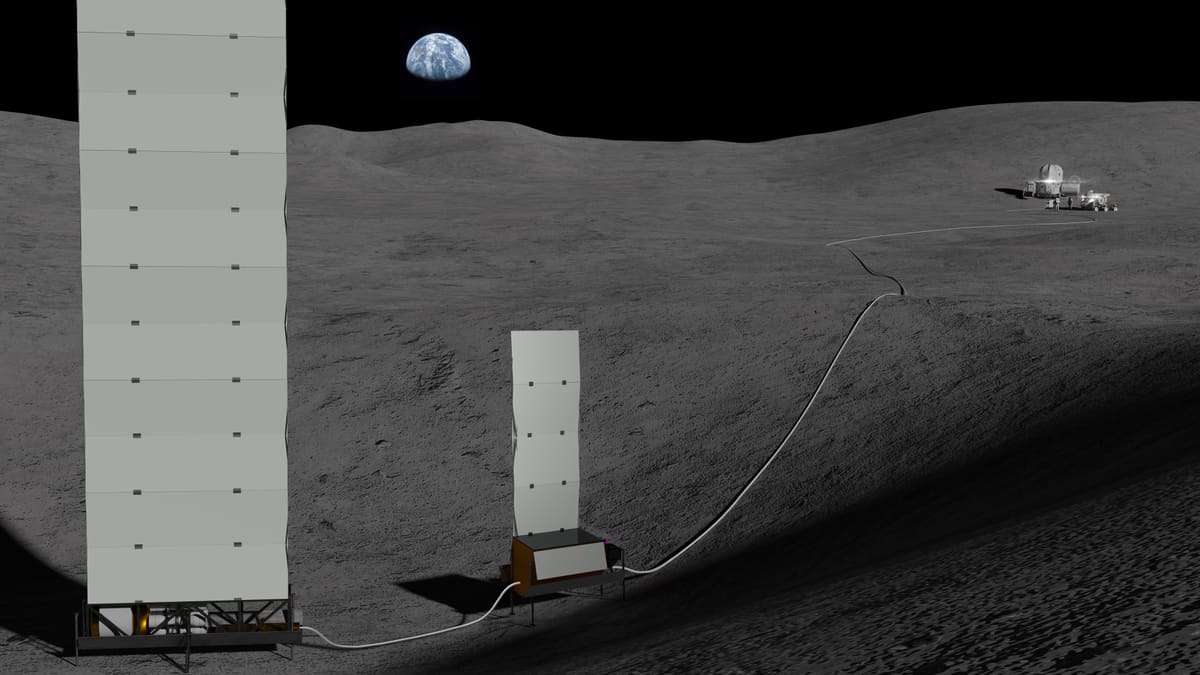
NASA is seeking industry partners to design and test Lunar Reactor-1 (LR-1), a 20-kilowatt fission power system intended to generate electricity on the Moon. The agency’s Request for Proposals (RFP), announced November 23, covers preliminary design and hardware demonstrations; proposals are due December 21.
The reactor is designed for lunar nights and equipment failures
Unlike solar panels, LR-1 is intended to generate electricity continuously, including through the Moon’s nights, which last about 14 Earth days. NASA says the power could support future habitats, communications systems, rovers and scientific instruments.
The solicitation calls for the system to maintain its 20-kilowatt output after a single failure. It is designed to operate automatically and continuously for at least five years without maintenance, with intermittent communications from Earth. It should also be able to shut down temporarily and restart without a loss of performance.
NASA’s timeline puts the launch-ready target at December 2030. After deployment, the agency plans to operate the system on the Moon for at least five years.
Contractors must test hardware before a flight system is built
Selected partners will have 18 months to complete component-level radiation exposure testing and hardware demonstrations, including an electrically heated integrated systems test. They must also design, build and test a nonnuclear Engineering Test Unit using full-scale components in a lunar-relevant thermal-vacuum environment. The unit must demonstrate heat transport, power conversion, heat rejection, and power management and distribution.
The reactor is not to be operated at power before landing on the Moon, although a zero-power critical test before launch is allowed. The system must work in conditions at the lunar south pole, including at least 14.75 days of continuous darkness. At mission completion, it must be shut down safely and enter a permanent, passive safe state.
Department of Energy standards govern nuclear safety
LR-1 must meet Department of Energy safety standards for nuclear operations, including the DOE-STD-1271 authorization pathway for nuclear facilities. Its shielding must limit the annual dose to crew in a habitable zone one kilometer away to no more than 5 roentgen equivalent man (rem) above the lunar background.
NASA’s Space Reactors Division manages LR-1 in partnership with the Department of Energy. The division is also responsible for Space Reactor-1 (SR-1) Freedom, which NASA schedules to launch in 2028. SR-1 Freedom is to deliver three SkyFall helicopters to Mars and demonstrate nuclear electric propulsion, which uses electricity from a reactor to power spacecraft propulsion systems.
NASA may issue additional task orders under the solicitation for other space nuclear power systems. It did not disclose the value of the work or a schedule for selecting partners.


More on US Department of Energy