Deep Isolation begins Texas site work for borehole pilot
The drilling permit covers a non-radioactive demonstration and does not authorize radioactive-waste disposal.
Key facts
- Deep Isolation announced October 28 that well-pad construction had begun near Cameron, Texas
- Pilot will test borehole construction, surface handling, and canister emplacement and retrieval
- Deep Isolation was selected as sole industrial partner on three DOE Project GENESIS grants
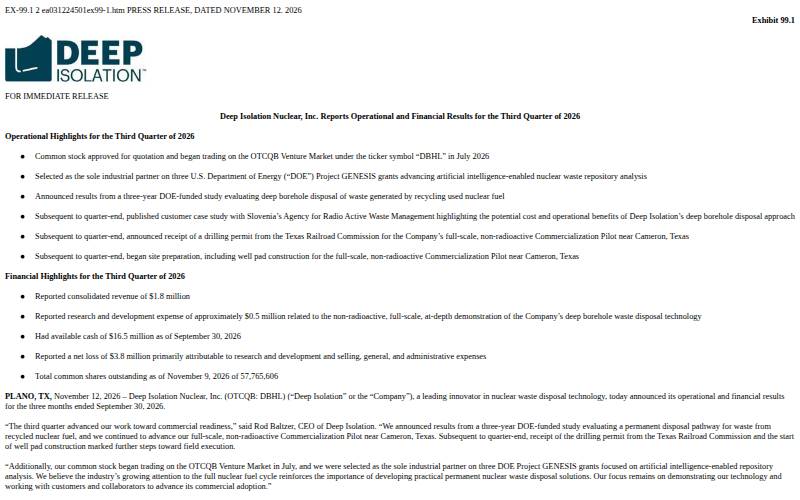
Deep Isolation Nuclear began site preparation, including well-pad construction, for its full-scale, non-radioactive deep-borehole pilot near Cameron, Texas, the company said on November 12. Deep Isolation announced on October 1 that the Texas Railroad Commission had issued a drilling permit, allowing the project to advance toward construction and field activities, but not authorizing disposal of radioactive waste.
The pilot is designed to test borehole construction, surface handling, and full-scale emplacement and retrieval of the company’s Universal Canister System. Deep Isolation is conducting it with the Deep Borehole Demonstration Center, Halliburton, Amentum, NAC International, and Occlusion Nuclear Solutions, using non-radioactive packages to simulate repository operations. The company gave no timetable for drilling or completing the pilot.
Deep Isolation was also selected as the sole industrial partner on three DOE Project GENESIS grants: two projects are led by Lawrence Berkeley National Laboratory and one by the University of South Carolina. In results from a separate three-year DOE-funded study, all disposal scenarios were projected to cost less than the program’s target of 0.1 cent per kilowatt-hour, and all scenarios under expected conditions met the study’s safety performance criteria.
For the quarter ended September 30, Deep Isolation reported revenue of $1.787 million and a net loss of $3.764 million, compared with $1.683 million in revenue and a $1.307 million net loss a year earlier. Research and development expense was $450,000, related to long-lead items and front-end engineering for the pilot; cash stood at $16.5 million at quarter-end.
