Jaguar reports 14.1 million inferred pounds of uranium at Berlin
The estimate covers 2.9 km of a 10.5 km mineralized trend; 1.2 million pounds are classified as indicated.
Key facts
- 14.1 million pounds of inferred uranium oxide at 562 parts per million
- 1.2 million pounds of indicated uranium oxide at 561 parts per million
- Mineral resources use a US$245/t net smelter return cut-off; they are not reserves
- Jaguar reports nearly US$18 million in cash and no debt
Jaguar Uranium has published an independent mineral resource estimate for the first 2.9 km of its Berlin project in Colombia, defining 1.2 million pounds of indicated uranium oxide and 14.1 million pounds of inferred uranium oxide. The estimate, prepared by SLR International Corporation and effective November 5, 2026, covers part of a mineralized trend that extends about 10.5 km, the company said on November 25.
The estimate includes two resource confidence categories
The indicated resource contains 937 kilotonnes grading 561 parts per million uranium oxide (U₃O₈). The inferred resource contains 11,343 kilotonnes grading 562 parts per million. Inferred resources have lower confidence than indicated resources and cannot be converted directly into reserves.
The estimate also includes vanadium, phosphate, rare earth elements, nickel, zinc and molybdenum. Jaguar says credits from these metals bring some blocks with moderate uranium grades into the resource: blocks grading 400–600 parts per million U₃O₈ can exceed the cut-off when they contain higher concentrations of co-products.
SLR used a net smelter return (NSR) cut-off of US$245/t. NSR incorporates assumed metal recoveries and off-site freight, smelting and refining charges. The uranium calculation assumes a long-term price of US$105/lb U₃O₈ and a 96.1% recovery. The cut-off is based on assumed mining costs of US$47.85/t, processing costs of US$191.40/t and general and administrative costs of US$5.22/t.
The estimate uses conceptual underground mining shapes to assess whether extraction could have reasonable prospects. Those assumptions do not demonstrate economic viability: Jaguar has not estimated mineral reserves.
The estimate leaves much of the trend outside its boundary
The mineralization lies in a carbonaceous packstone layer, a sedimentary rock unit, that is 1–8 m thick. The layer extends along a folded structure, and the current estimate covers the southern 2.9 km. Jaguar says exploration drilling, trenching and surface mapping indicate the mineralized horizon remains open to the north for another 7.6 km.
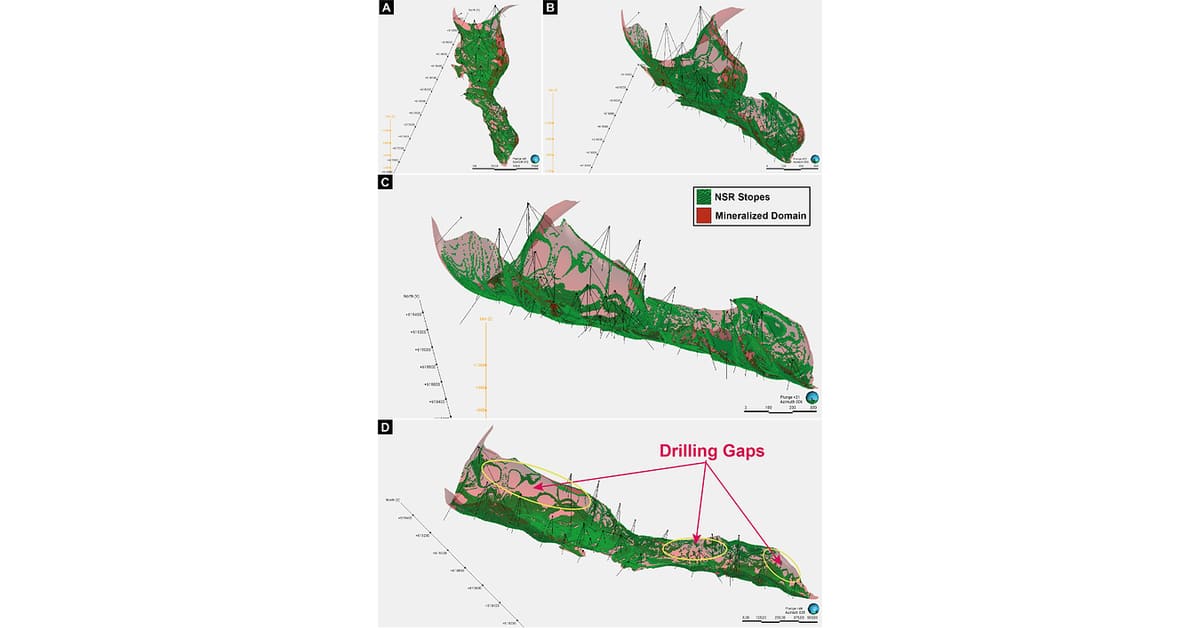
The estimate excludes a near-surface mineralized layer extending from the surface to about 25 m depth. Jaguar says it would require open-pit mining methods and a separate technical and economic assessment. Within the estimated area, SLR identified sampling gaps, particularly on the eastern flank.
Drilling and technical filings remain ahead
Jaguar plans exploration drilling, trenching and mapping along the northern trend, as well as infill diamond drilling to address gaps and potentially raise confidence in inferred material. The company also plans further metallurgical and geotechnical work. These are planned activities, not completed work.
SLR reviewed historical sampling and quality-control data, along with Jaguar’s 2026 verification program, which independently reanalyzed 150 archived drill-core and pulp samples. The qualified persons considered the data sufficiently reliable to support the estimate, while noting limitations in historical analytical documentation and variability in individual assay results.
Jaguar said a supporting technical report would be filed within 45 days, with a separate technical summary to be filed with the US Securities and Exchange Commission.

